
August 14, 2026
If you’ve been arrested for DUI in California, “wet reckless” may be the most important term you’ve ever heard of. It’s the most common reduced charge in California DUI cases, and whether you should pursue it, accept it, or push for something better depends on facts most people don’t know to ask about. Here’s how it actually works, based on the current statute.
A wet reckless is a conviction for reckless driving under California Vehicle Code 23103, entered through a plea bargain in a DUI case, with a formal notation under Vehicle Code 23103.5 that alcohol or drugs were involved. It is a misdemeanor that carries lighter penalties than a DUI, but it still counts as a prior DUI if you are convicted of another DUI within 10 years.
Three things follow from that definition:
People use “VC 23103.5” as shorthand for the whole charge, but the wet reckless is actually built from two statutes working together.
Vehicle Code 23103 defines reckless driving as driving “in willful or wanton disregard for the safety of persons or property.” That is the offense you are actually convicted of. Under VC 23103(c), it is punishable by 5 to 90 days in county jail, a fine of $145 to $1,000, or both.
Vehicle Code 23103.5 is the plea-bargain statute. When a prosecutor agrees to reduce a DUI charge (VC 23152) to reckless driving, the statute requires the prosecution to state on the record whether alcohol or drugs were involved in the offense. If they were, that statement (the “wet” notation) has two major effects:
The court is also required to advise you of these consequences before accepting the plea, so if you take a wet reckless, you will hear this warning from the judge directly.
One detail almost no one mentions: by its own terms, VC 23103.5 remains in effect only until January 1, 2033, when it is repealed unless the Legislature extends it. The wet reckless as we know it is a legislative creation with a built-in sunset, a reminder that DUI law in California changes regularly, and what was true a few years ago may not be true today.
A wet reckless is a misdemeanor. Here is what a conviction typically involves:
| Penalty | Wet Reckless (VC 23103 / 23103.5) |
| Jail | 5 to 90 days county jail (often avoided entirely for first offenses, depending on the case and county) |
| Base fine | $145 to $1,000, plus court assessments |
| Probation | Commonly 1 to 2 years of informal probation |
| DUI program | If probation is granted, at minimum the educational component of a licensed DUI program, commonly a 12-hour class (VC 23103.5(e)) |
| Court-ordered license suspension | None from the conviction itself |
| Ignition interlock device | Not mandatory; the court may order one for at least 3 months (VC 23103.5(g)) |
| DMV points | 2 points on your driving record |
| Priorability | Counts as a prior DUI for 10 years |
Two rows deserve a closer look, because they’re where competitor articles most often get the law wrong:
The DUI program requirement scales up if you have priors. Under VC 23103.5(f), if your wet reckless follows a prior wet reckless or DUI conviction within 10 years and you are placed on probation, the court must order a licensed program of nine months or longer with at least 60 hours of activities, not the short educational class. The “12-hour class” benefit is largely a first-offense benefit.
The IID is discretionary, not absent. Since 2019, VC 23103.5(g) has allowed, but not required, the court to order an ignition interlock device for at least three months after a wet reckless conviction. Most first-offense wet reckless outcomes do not include an IID, but “no IID ever” overstates the rule.
Compared to a first-offense DUI conviction, a wet reckless generally means:
For a full side-by-side breakdown of every penalty, see our guide to DUI vs. wet reckless in California.
A wet reckless is a reduction, not a reset. Four things survive the plea:
When you are arrested for DUI in California, two cases start at once: the criminal case in court and an Administrative Per Se (APS) action at the DMV. A wet reckless plea resolves only the first one.
The DMV’s suspension, typically 4 months for a first offense, proceeds independently unless you request an administrative hearing within 10 days of your arrest and win it. If you missed the deadline or lost the hearing, the administrative suspension applies even though your court case ended in a wet reckless, and reinstatement generally requires an SR-22 filing from your insurer.
That means there are really two versions of a “wet reckless outcome”:
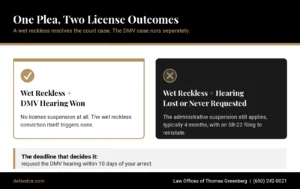
The first scenario is the genuinely clean outcome. It’s why the 10-day DMV deadline matters more than anything else in the early days of a DUI case. Our guide to the DMV hearing after a DUI arrest walks through the process and what it takes to win.
There is no legal right to a wet reckless, and no form you can file to request one. The reduction happens when a prosecutor concludes that reducing the charge is a better outcome for their office than risking trial. Understanding that incentive is the key to understanding the process.
Prosecutors typically agree to a wet reckless when the DUI case has a problem worth pricing in. The most common ones:
For a deeper look at the defense side of this equation, see our guide on how DUI charges get challenged in California.
Honesty matters here: wet reckless offers are far less common when the case involves a high BAC (0.15% and above), a collision or injury, a chemical test refusal, children in the vehicle, or a prior DUI record. In those cases, the realistic goals usually shift to reducing penalties within a DUI plea or contesting the case on its merits. An experienced defense lawyer can tell you which category your case falls into after reviewing the evidence, not before.
If the court accepts a wet reckless plea and places, you on probation, expect:
Complete everything on time. A probation violation can convert a good outcome into a bad one quickly, and failing to enroll in or complete the required program is grounded for the court to revoke probation.
The answer depends on which record you mean. Competing articles give conflicting numbers because they blur three different things:
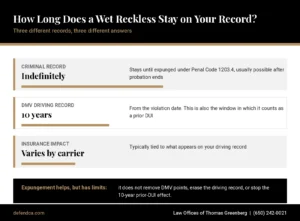
Expungement is usually available. Once you complete probation, a wet reckless can generally be expunged under Penal Code 1203.4, which withdraws the guilty plea and dismisses the case. Because wet reckless probation is shorter than DUI probation, you typically become eligible sooner than you would after a DUI conviction. After expungement, you can generally answer “no” to conviction questions from most private employers under California law.
Know the limits. Expungement does not remove the conviction from your DMV driving record, does not erase the 2 points, and does not eliminate priorability. An expunged wet reckless still counts as a priority if you pick up a new DUI within the 10-year window. It also must still be disclosed in certain contexts, such as applications for state professional licenses and public office. Our California expungement guide covers the process and its limits in detail.
Commercial driver’s license holders. The stakes and the rules are different for CDL holders. Points are calculated differently, and reckless driving carries its own consequences under commercial licensing rules. Do not accept any plea before getting advice specific to commercial licensing.
Licensed professionals. Nurses, physicians, attorneys, CPAs, teachers, and other licensees may have reported obligations to their licensing boards, and boards look at the underlying conduct, not just the charge of name. A wet reckless is generally viewed more favorably than a DUI, but the analysis is profession specific. See our guides for attorneys, doctors, and nurses facing alcohol-related charges.
Non-citizens. DUI-related convictions rarely trigger removal by themselves, but immigration consequences depend on the full record and any related conduct. Any non-citizen should have plea language reviewed with immigration consequences in mind before accepting it. Our guide on DUI and immigration consequences in California explains what to watch for.
Whether a wet reckless is offered, and on what terms, varies with the facts of the case, the strength of the evidence, the prosecuting office, and the court. There is no county where reductions are automatic, and no county where they are impossible.
That said, local experience matters in practical ways. San Mateo County DUI cases are handled through the San Mateo County Superior Court, with most criminal matters heard at the Hall of Justice in Redwood City. Knowing how the local District Attorney’s office evaluates borderline cases, what documentation moves the needle, and how to sequence the court case against the DMV hearing (handled through the DMV’s driver safety office) is the kind of ground-level knowledge that shapes outcomes in negotiated cases.
Thomas Greenberg has defended DUI cases in San Mateo County for over two decades, including years as a Deputy Public Defender in the county before entering private practice in Redwood City. That background means familiarity with the local courts and prosecutors from both sides of the aisle. For the county-specific process from arrest through resolution, start with ours San Mateo County DUI defense guide.
A wet reckless can be a genuinely good result. It can also be less than your case deserves; early offers sometimes signal that the prosecution sees a problem you haven’t found yet. The only way to know which is true is to have evidence reviewed by someone who knows what to look for.
If you’re facing a DUI charge in San Mateo County or the surrounding Bay Area, or you’ve already been offered a wet reckless and aren’t sure whether to take it, they Law Offices of Thomas Greenberg can review the facts of your case, explain the realistic range of outcomes, and handle both the court case and the DMV hearing. Call (650) 242-0021 for a free consultation. Remember the 10-day DMV deadline: the earlier the review happens, the more options stay open.


 Cannabis (4)Crime Defense (7)Drug Crimes (2)DUI (25)Expungements (4)Felony (7)ICE (2)Juvenile (1)Juvenile Justice (2)Local Insights (5)Marijuana Laws (3)Miranda Rights (1)Misdemeanor (1)Penal Code 4019 (1)Probation (1)TAKE IT DOWN Act (2)Traffic (6)Uncategorized (0)Warrants (3)


 (650) 242-0021