
March 17, 2026
Generative AI has quickly moved from research labs into everyday tools. People now use AI to draft emails, create images, automate tasks, and even generate voice recordings. While these tools can improve productivity and creativity, they also raise new legal questions.
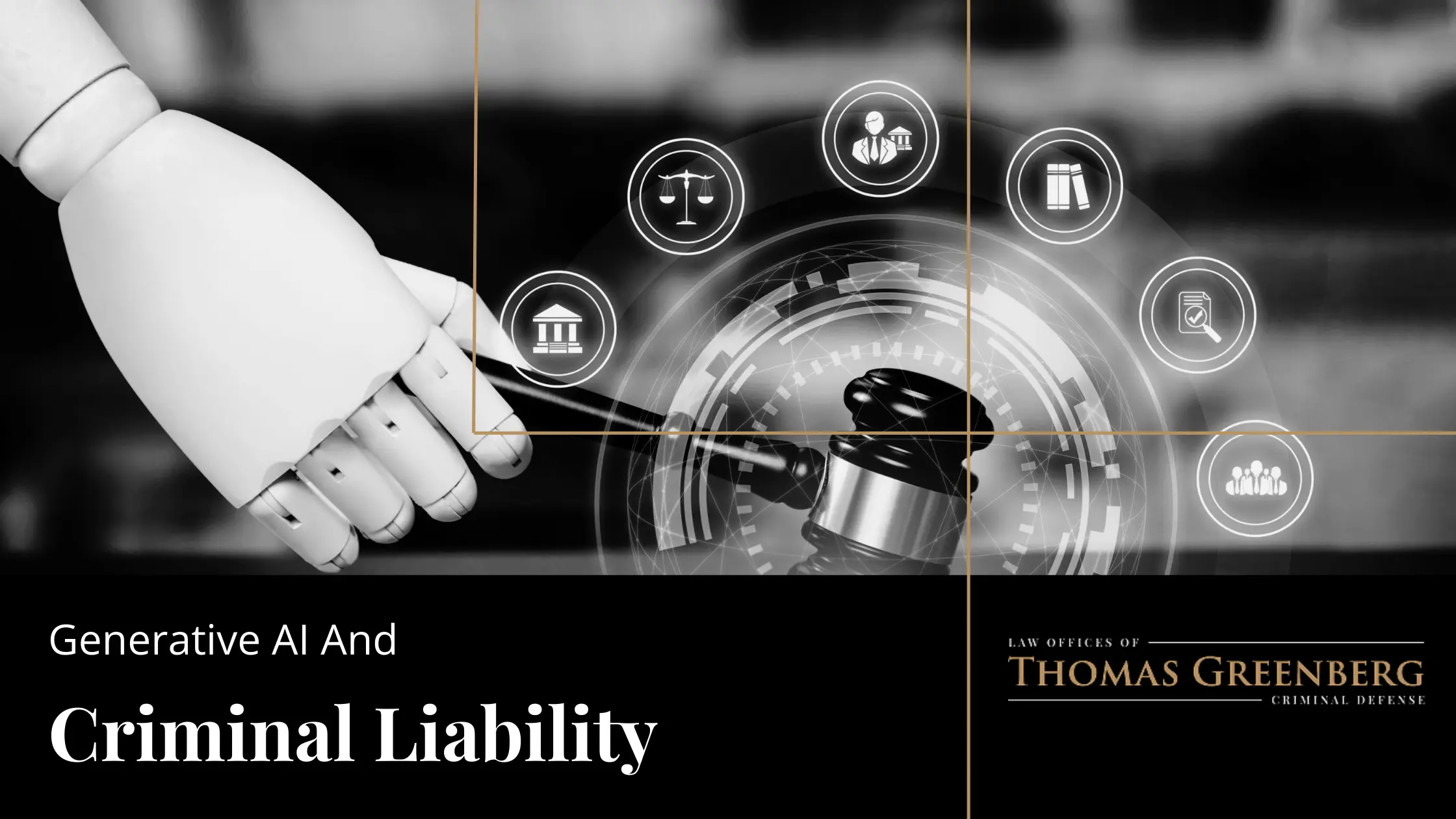
One of the biggest concerns involves criminal liability related to generative AI. When an AI system produces harmful content or helps someone commit a crime, the legal system must determine who is responsible. Is it the person who used the AI tool? The developer who created the system? Or is the company hosting the platform?
Courts and regulators across the United States, including California, are working through these issues. In January 2025, the California Attorney General issued advisories confirming that existing state laws already apply to artificial intelligence systems. That means AI-related misconduct can still trigger civil or criminal penalties.
This article explains how generative AI fits into current criminal law, what risks individuals should understand, and how legal professionals are approaching this evolving field.
Generative AI refers to systems that create new content based on patterns learned from large datasets. These systems can generate text, images, video, audio, or computer code.
Common examples include:
These tools can produce highly realistic content. That realism is powerful, but it can also lead to problems when the content is misleading or harmful.
For example, AI-generated messages can imitate real people, while deep-fake videos can make someone appear to say something they never said. In the wrong hands, these tools can enable fraud, impersonation, and harassment.
Using generative AI is not illegal. Millions of people rely on AI tools for work, education, and personal projects.
Problems arise when someone uses AI to commit actions that already violate the law.
For instance, AI could help someone generate phishing messages that trick victims into sending money. Voice cloning could allow a scammer to impersonate a company executive. AI-generated threats or harassment messages could also trigger criminal investigations.
In those cases, technology itself is not a crime. The illegal activity is the same type of misconduct prosecutors have pursued for years. AI simply becomes the tool used to carry it out.
Federal statutes such as wire fraud laws and the Computer Fraud and Abuse Act (CFAA) can apply when AI is used to carry out digital crimes. State laws, including identity theft and harassment of statutes, may also apply.
Many people assume that artificial intelligence operates in a legal gray area. Regulators have emphasized that existing laws already govern many AI activities.
The California Attorney General issued two legal advisories in January 2025 explaining how current state laws apply to AI systems. These advisories focus on areas such as:
California has also enacted new rules addressing issues like AI-generated political content, digital impersonation, and disclosure requirements. These measures aim to reduce harm from deceptive AI systems.
While these laws often target businesses deploying AI technology, they also reinforce an important point: using AI does not shield anyone from legal responsibility.
Determining liability in AI-related cases can be complicated. Courts usually focus on the actions and intentions of the people involved.
In most situations, the person who uses an AI tool to commit a crime bears the primary responsibility. If someone knowingly uses AI to impersonate another person or conduct a fraud scheme, prosecutors will likely target that individual.
Companies that create AI systems may face legal scrutiny if they knowingly enable harmful uses or fail to address obvious risks. However, proving liability against developers can be difficult.
Legal debates often involve Section 230 of the Communications Decency Act, which provides certain protections for online platforms hosting third-party content. Courts are still determining how these protections apply to generative AI.
Criminal liability typically requires proof of intent or knowledge. Prosecutors must show that a person deliberately used AI in a way that caused harm or violated the law.
That requirement can complicate AI cases because generative systems sometimes produce unexpected outputs.
AI-generated content is already appearing in legal disputes. Lawyers and judges are working on how to treat these materials.
Courts generally require authentication of digital evidence before it can be admitted. That means someone must prove where the content came from and whether it is reliable.
AI creates challenges because it can generate convincing but fabricated media. Deepfake audio or video could mislead investigators if not carefully analyzed.
Attorneys often rely on digital forensics experts to verify whether media files were manipulated or generated by AI.
Another complication involves testimony. An AI system cannot be cross-examined like a human witness. Courts typically require human testimony or independent documentation to support claims based on AI output.
Criminal defense attorneys and prosecutors both encounter new challenges when AI enters a case.
One issue involves attribution. It can be difficult to prove who generated a particular piece of AI content. A shared computer or anonymous online account may create uncertainty.
Another challenge involves proving intent. A defendant might argue that an AI system produced harmful content without their knowledge.
Courts may also require expert testimony explaining how an AI model works and whether its outputs are predictable or reliable.
These complexities mean AI-related cases often involve technical experts, digital evidence analysis, and extensive forensic review.
People can enjoy the benefits of AI tools while minimizing legal risk. A few practical steps can help.
Responsible use of these technologies helps reduce the chance of legal trouble.
If law enforcement contacts you about AI-generated content, it is important to respond carefully.
First, avoid deleting files or communications that may relate to the situation. Digital evidence can become important in explaining how AI tools were used.
Second, avoid discussing the issue publicly or posting it online. Statements made online can easily become evidence.
Finally, speak with a criminal defense attorney experienced in digital evidence and technology-related cases. Legal guidance early in the process can help protect your rights and clarify what actually occurred.
Artificial intelligence is evolving faster than laws designed to regulate it. Policymakers across the United States are exploring new rules related to deepfakes, AI transparency, and automated decision-making.
At the same time, courts continue applying traditional legal principles to modern technology. Concepts such as intent, fraud, and identity theft still form the foundation of criminal law.
As AI tools become more common, understanding these principles will become even more important for businesses, professionals, and everyday users.
Generative AI offers powerful capabilities, but misuse can create serious legal exposure. Existing laws already cover many forms of AI-related misconduct, including fraud, impersonation, and harassment.
For individuals and organizations, the safest approach is responsible for use and awareness of how AI tools operate. As technology continues to advance, legal systems will adapt to address new challenges.


 Cannabis (4)Drug Crimes (2)DUI (18)Expungements (3)Felony (5)Juvenile Justice (2)Local Insights (4)Marijuana Laws (3)Miranda Rights (1)Misdemeanor (1)Penal Code 4019 (1)Probation (1)TAKE IT DOWN Act (2)Traffic (6)Uncategorized (0)Warrants (3)
 (650) 242-0021