Blog Image

PC 273.5 Corporal Injury on a Spouse: Charges, Penalties & Defenses in California

August 10, 2026

Summary 

  • PC 273.5 makes it a crime to willfully inflict a physical injury that causes a “traumatic condition” on a spouse, cohabitant, dating partner, or the parent of your child. Even a minor injury such as a bruise or swelling can qualify, and strangulation counts even without visible marks. 
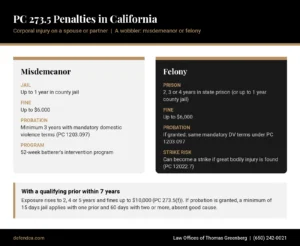
  • It is a wobbler: chargeable as a misdemeanor (up to 1 year in county jail) or a felony (2, 3 or 4 years in state prison), each with fines up to $6,000. A qualifying prior within 7 years raises exposure to 2, 4 or 5 years and $10,000. 
  • Probation carries mandatory terms under PC 1203.097: at least 36 months of probation, a criminal protective order, and a 52-week batterer intervention program. 
  • Convictions on or after January 1, 2019, carry a lifetime firearm ban under California law, and the sentencing court must consider a protective order of up to 15 years. 
  • The alleged victim cannot drop the charges; the District Attorney decides. But recantation, self-defense, accident, and the injury element itself are all real defense terrain. 

Introduction 

A PC 273.5 arrest moves fast: someone is taken from the home, an emergency protective order issues, and by the time of the first court to date the case has a momentum of its own. This guide explains what the charge requires the prosecution to prove, the realistic penalty picture, and where defense leverage comes from, based on the current statute text. 

What Is PC 273.5? 

California Penal Code 273.5 prohibits willfully inflicting “corporal injury resulting in a traumatic condition” on a current or former spouse, cohabitant, fiancé(e) or dating partner, or the parent of your child. In plain English: causing any physical injury, however minor, to an intimate partner. It is the most serious of California’s two core domestic violence charges and can be filed as a misdemeanor or a felony. 

PC 273.5 is often confused with PC 243(e)(1) domestic battery, the lesser charge. The difference is injury: domestic battery requires only offensive touching and is always a misdemeanor. PC 273.5 requires an actual bodily injury, which is why prosecutors treat it more seriously and why reducing a 273.5 to a 243(e)(1) is a common defense objective. Our overview of the types of domestic violence charges covers how the related offenses fit together. 

What the Prosecutor Must Prove 

A PC 273.5 conviction requires proof beyond a reasonable doubt of three elements: a willful act, a corporal injury that caused a traumatic condition, and a qualifying relationship. Each is a potential pressure point. 

  1. A willful act

“Willfully” means on purpose. The prosecution does not need to prove intent to break the law or to cause the specific injury, only that the physical act itself was deliberate. This is why genuinely accidental injuries, such as those from a fall during a chaotic argument or an unintended collision, are not corporal injuries. 

  1. Corporal injury resulting in a traumatic condition

A “traumatic condition” is any wound or external or internal injury caused by physical force, whether minor or serious. A bruise, a cut lip, swelling, or a sprain can qualify. The statute also expressly includes injuries from strangulation or suffocation, defined as impeding normal breathing or blood circulation by pressure on the throat or neck, which means strangulation allegations can support the charge even with no visible injury. 

What does not qualify: pain alone, fear, or emotional harm without a physical injury. If there is no traumatic condition, the conduct may still be domestic battery, but it is not PC 273.5. 

  1. A qualifying relationship

The alleged victim must be a current or former spouse, a current or former cohabitant, a fiancé(e) or someone in a current or former dating relationship, or the mother or father of the accused child. Roommates without an intimate relationship do not qualify; the same conduct would be charged under general assault and battery statutes instead. 

Misdemeanor or Felony? How the Wobbler Decision Gets Made 

PC 273.5 is a wobbler, meaning the District Attorney chooses to file it as a misdemeanor or a felony, and a felony filing can later be reduced under PC 17(b). The charging decision typically turns on the seriousness of the injury, any prior to domestic violence history, whether strangulation is alleged, whether children were present, and the strength of the evidence. 

Having spent years as a Deputy Public Defender in San Mateo County, Thomas Greenberg has watched these filing decisions from inside the courthouse: the same physical altercation can be filed as a misdemeanor or a felony depending on the injury photographs, the 911 recording, and what the charging deputy sees in the file on day one. That is why the earliest days of a case, before the preliminary hearing and sometimes before filing, are often where the widest range of outcomes is still available. 
PC 273.5 Penalties

pc 273 5 penalties california

If probation is granted, PC 1203.097 makes certain terms mandatory in every domestic violence case: at least 36 months of probation, a criminal protective order, a $500 domestic violence fee (waivable on inability to pay), community service, booking within one week of sentencing, and successful completion of a batterer’s intervention program of at least a year of weekly two-hour sessions, finished within 18 months, with no more than three excused absences. 

Felony sentences can also gain enhancements. If the injury amounts to great bodily injury, a PC 12022.7 enhancement adds prison time and can convert the conviction into a strike under California’s Three Strikes law, depending on the findings. 
Consequences Beyond the Sentence

pc 273 5 consequences beyond sentence

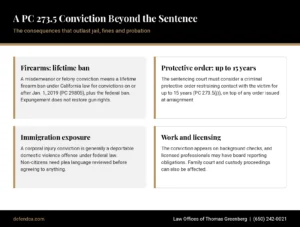
  • Firearms: a lifetime ban. For convictions on or after January 1, 2019, even a misdemeanor PC 273.5 conviction triggers a lifetime firearm prohibition under Penal Code 29805, alongside the federal ban for misdemeanor crimes of domestic violence (18 U.S.C. § 922(g)(9)). Expungement does not restore firearm rights. 
  • A protective order of up to 15 years. At sentencing the court must consider a criminal protective order restraining contact with the victim for up to 15 years under PC 273.5(j), on top of any order issued at arraignment. Violating it is a new crime, even if the protected person initiates contact. See our guide on contact after a restraining order. 
  • Immigration. A corporal injury conviction is generally a deportable domestic violence offense under federal immigration law. Non-citizens should not accept any plea before the language is reviewed with immigration consequences in mind. Our guide on how a conviction can lead to deportation explains the framework. 
  • Employment and licensing. The conviction appears on background checks, and many licensed professionals, a significant share of San Mateo County’s workforce, have board reporting obligations. Family court and custody proceedings can also be affected. For the full post-conviction picture, see what a domestic violence conviction means. 

Can the Victim Drop the Charges? 

No. Once a report is made, the decision to file, pursue, or dismiss charges belongs to the District Attorney, not the alleged victim. This surprises families constantly: a spouse who regrets the call cannot end the case, and prosecutors routinely proceed with reluctant or recanting witnesses using the 911 recording, body-camera footage, injury photographs, and medical records. 

A recantation still matters, but as evidence to be weighed rather than an off switch. How and when it is presented, and whether it is corroborated, is strategy work for defense counsel, not something to improvise. 

Defenses to PC 273.5 

The right defense depends on which element is weakest on the actual evidence. The ones that most often move cases: 

  • Self-defense or defense of others. If you reasonably believed you or someone else was in imminent danger and used only reasonable force, the conduct is not a crime. Mutual-combat situations, injuries on both parties, and who called 911 first all matter here. Our explainer on self-defense laws in California covers the standard. 
  • Accident. The act must be willful. Injuries from an unintended collision, a fall, or restraining someone who was falling are not willful infliction. 
  • No traumatic condition. If there is no physical injury, or the medical evidence does not connect the claimed injury to the alleged act, the charge overreaches and reduction to domestic battery, or dismissal, is on the table. 
  • False or exaggerated allegations. Custody disputes, breakups, and immigration or housing pressures produce documented false reports. Texts, prior statements, witness inconsistencies, and injury patterns inconsistent with the account are the raw material of this defense. 
  • No qualifying relationship. If the relationship does not meet the statute’s definitions, PC 273.5 is the wrong charge. 

In practice, defense work starts with the evidence file: 911 audio, body-camera video, photographs and their timestamps, medical records, and every prior statement. That review is what turns a defense theory into leverage, whether toward dismissal, a reduction to PC 243(e)(1), or a better resolution. Our guide on how criminal charges get dismissed in California explains the procedural paths. 

Reductions, Diversion, and Clearing Your Record 

Reduction paths 

Common negotiated outcomes include reducing a felony 273.5 to a misdemeanor under PC 17(b), or reducing the charge to domestic battery (PC 243(e)(1)) or another lesser offense. Which is realistic depends entirely on the evidence and history. 

Diversion: narrower than most articles admit 

Court-initiated misdemeanor diversion under PC 1001.95 is not available for domestic violence offenses; the statute excludes them expressly. The realistic diversion path in a DV case is mental health diversion under PC 1001.36, where a qualifying diagnosis, a treatment plan, and the court’s discretion align. Veterans may also have options under military diversion. Eligibility is fact-specific; treat any article that promises diversion in a DV case with caution. 

Expungement 

After successful completion of probation, a PC 273.5 conviction can generally be expunged under PC 1203.4, which dismisses the case for most private employment purposes. Expungement does not restore firearm rights, does not undo immigration consequences, and must still be disclosed for state licensing. See our California expungement guide for the process and limits. 

What Happens After a PC 273.5 Arrest in San Mateo County 

  1. Arrest and emergency protective order. Officers responding to a domestic violence call in California generally must make an arrest when there is visible injury, and typically obtain an emergency protective order lasting up to about a week, which can exclude you from your own home. 
  2. Charging decision. The San Mateo County District Attorney’s office reviews the report and decides whether to file, and at what level. Early defense contact, before charges are filed, is sometimes possible and occasionally changes the filing. 
  3. Arraignment and criminal protective order. Cases arising in most of the county are heard at the San Mateo County Superior Court, Southern Branch, in Redwood City (Hall of Justice); cases from the north county are heard at the Northern Branch in South San Francisco. At arraignment the court will typically issue a criminal protective order, which can be full stay-away or peaceful-contact depending on the facts and the victim’s input. 
  4. Pretrial litigation and resolution. Evidence review, motions, negotiation, and, where warranted, preliminary hearing and trial. Outcomes vary based on the facts, the court, the prosecutor, and the defendant’s record. 

Because Thomas Greenberg spent years as a San Mateo County Deputy Public Defender before opening his Redwood City practice, he has handled these cases from both the courtroom and the negotiation table in the same courthouses where they are heard today. For broader local context, see our San Mateo criminal defense overview. 

Facing a PC 273.5 Charge? Move Early 

The most consequential decisions in a corporal injury case, the charging level, the protective order terms, and whether the evidence gets tested before a plea, happen early. If you or a family member has been arrested under PC 273.5 in San Mateo County or the surrounding Bay Area, the Law Offices of Thomas Greenberg can review the evidence, appear at arraignment, address the protective order, and explain the realistic range of outcomes for your specific facts. Call (650) 242-0021 for a free consultation.

Tags:

Share This :


FAQs

Here are some answers to some commonly asked questions.

Both are possible. PC 273.5 is a wobbler: the DA can file it as a misdemeanor (up to 1 year in county jail) or a felony (2, 3 or 4 years in state prison). The injury severity, any prior history, and the case facts drive the choice, and a felony filing can later be reduced under PC 17(b).

Any wound or external or internal injury caused by physical force, whether minor or serious: bruise, swelling, a cut, a sprain. Strangulation or suffocation qualifies even without visible marks. Pain or fear alone, without physical injury, does not.

Injury. Domestic battery under PC 243(e)(1) requires only offensive touching and is always a misdemeanor. PC 273.5 requires an actual physical injury and can be a felony. Reduction from 273.5 to 243(e)(1) is a common negotiated outcome in weaker-injury cases.

No. The District Attorney controls the case, and prosecutors often proceed using the 911 call, photos, and medical records even when the alleged victim recants or refuses to cooperate. A recantation is evidence, not a dismissal.

Yes. For convictions on or after January 1, 2019, California imposes a lifetime firearm ban even for misdemeanor PC 273.5 (Penal Code 29805), and federal law imposes its own lifetime ban. Expungement does not restore firearm rights.

Generally, yes, under PC 1203.4 after probation is successfully completed. Expungement helps most private-employer background checks, but it does not restore gun rights, erase immigration consequences, or eliminate licensing disclosure obligations.

Not automatically. It becomes a serious felony, and therefore a strike, when a great bodily injury enhancement (PC 12022.7) or similar finding attaches to a felony conviction. Whether that exposure exists in a given case depends on the injury of evidence.

An emergency protective order lasts about a week. A criminal protective order issued at arraignment typically lasts through the case. On conviction, the court must consider a protective order of up to 15 years under the current version of PC 273.5(j), effective January 1, 2025.

Not general misdemeanor diversion; PC 1001.95 expressly excludes domestic violence offenses. Mental health diversion under PC 1001.36 can be available where its criteria are met, and veterans may qualify for military diversion. Eligibility is fact specific.

Many first-offense cases with minor injuries are filed as misdemeanors, and probation with the mandatory 52-week program is a common outcome. But even a misdemeanor conviction carries the lifetime gun ban, the protective order, and immigration exposure, which is why negotiating the charge itself matters.

It can. A corporal injury conviction is generally a deportable domestic violence offense under federal law, and depending on the record it can create additional inadmissibility problems. Non-citizens should have any proposed plea reviewed for immigration consequences first.

It can. Many California licensing boards require conviction reporting and evaluate the underlying conduct. Teachers, nurses, physicians, attorneys, security-clearance holders, and others should raise licensing exposure with counsel at the start, not after a plea.
Group 1000001910
Call Now Button